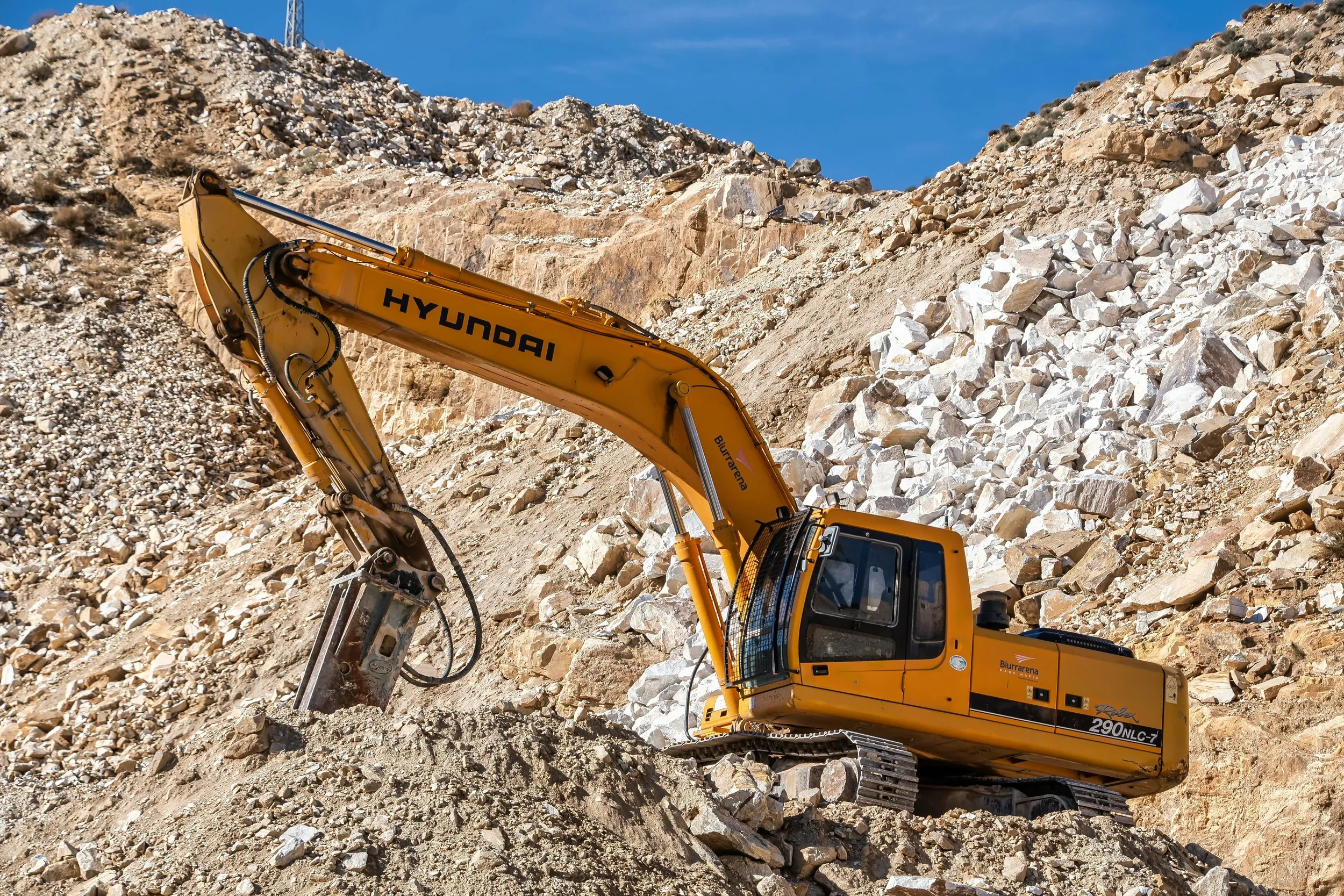
Stone Quarries
 Stone Quarries
The second most important resource need for societies after basic necessities and energy is industrial rocks and minerals. Today, excavation is essential to obtain the industrial rocks and loose materials required for one of humanity’s basic needs: housing, workplaces, and transportation routes. We have no choice but to extract these natural stones and materials from their natural environment. In the extraction of these industrial rocks and materials, the demanded rock mass/particle size and quality come to the forefront. Proximity to the area of use is another fundamental factor.
We can divide the usage areas of stone quarry operations into two main groups:
a. Industrial rocks / Minerals (Limestone, dolomite, marl, clays, gypsum)
b. Infrastructure and above-ground / underground structures and buildings
A. Basic infrastructure constructions (Transportation roads, coastal protection, port constructions, dams, ponds, etc.)
B. Housing and workplace structures (Crushed stone)
C. Cement / Metallurgy Sector
D. Paper, paint, glass, fertilizer Sector
E. Chemical and Health etc. Sectors
In the construction sector, usage varies according to the volumetric-particle size of the material: Large block rock, Dimension stone (Sized or unsized), Large fill material, stabilized material, Crushed stone, Fine sand, Asphalt aggregate and filler, Residential construction, structural elements. Buyers include institutions, concrete plants, municipalities, highways and railways, DSI, private individuals, and companies.
In Türkiye, demand for construction materials is rapidly increasing due to the fast-developing residential areas, industrial zones, and commercial centers. On the other hand, quarries located close to settlement areas and their surroundings are becoming part of urban zones. This creates a contradiction. The conflict between stone quarry operations and urban settlement areas emerges as a significant issue in major cities.
In general, the issues to be considered in the design of an open-pit quarry operation are:
- Bench and overall pit slope angle and stability analyses must be conducted.
- The geometry of the quarry to be opened should be planned as partially naturally screened, taking into account the geometry of the natural stone deposit, without creating visual disturbances on main roads.
- To prevent physical pollution of water, air, and soil environments, the planning of quarry and dump sites and the rehabilitation of dumps into nature should be well designed and returned to the economy.